
- All
- Product Name
- Product Keyword
- Product Model
- Product Summary
- Product Description
- Multi Field Search
Views: 0 Author: Site Editor Publish Time: 2026-02-12 Origin: Site


Ever wondered why one batch flows clean while another smells or hazes?
Many teams now ask how liquid paraffin is made, because quality starts at the refinery.
In this article, you will learn the production steps, key quality checks, and how buyers choose reliable grades for real applications.
Liquid paraffin is a refined blend of saturated hydrocarbons, mainly alkanes and cycloalkanes. It is valued for chemical stability, low odor, and predictable flow. Although buyers often treat it as a commodity, production quality varies widely. Differences in aromatic content, wax residues, and polishing levels can cause yellow tint, odor, poor cold clarity, or unstable formulations.
● Liquid paraffin vs mineral oil vs white oil — clarifying terminology
Mineral oil refers to the broad petroleum-derived category. White oil usually signals deeper refining and improved appearance.Liquid paraffin commonly describes high-purity white oil used in industrial applications, as well as in daily chemicals and pharma-adjacent applications. In sourcing, these labels matter less than test results such as UV absorbance, sulfur level, color, and viscosity stability.
● Why production methods affect purity, safety, and performance
Manufacturing steps determine what remains in the final oil. Elevated aromatics increase odor and regulatory risk, while residual wax causes haze and poor low-temperature flow. Modern hydrotreating, precise dewaxing, and strong filtration deliver cleaner, more stable liquid paraffin, reducing formulation issues and production rework.
● Typical industries using tightly controlled liquid paraffin
Liquid paraffin supports plasticizers, rubber and plastic processing, coatings, and daily chemicals. It also serves as a feedstock for chlorinated paraffins and fatty alcohols, where carbon range and impurity control directly impact reaction efficiency and yield.
Liquid paraffin manufacturing is best understood as a sequence of “separate, then purify” operations, where each stage removes a different group of undesired components, and the total sequence determines whether the final product is a technical-grade oil or a cleaner oil suited for daily chemicals or more regulated channels. While exact parameters vary by refinery configuration, the logic remains consistent, and a buyer can use this logic to evaluate whether a supplier’s product story matches realistic production capability.
Manufacturers start by selecting crude oil and refinery streams that favor a paraffinic character, because paraffinic feed tends to provide a higher proportion of saturated hydrocarbons and a lower baseline of aromatics, which reduces purification burden downstream. Feedstock choice also affects finished viscosity range and color potential, since heavier or more aromatic feed requires more severe treatment to reach the same clarity and odor profile, and it can push costs upward while still risking variability. For B2B buyers, it is useful to ask whether the supplier controls feed selection, whether they use consistent base oil cuts, and whether they can explain how feed variation is managed through process control and testing.
After crude processing, liquid paraffin usually comes from heavier distillates associated with lube oil production, and vacuum distillation helps isolate these fractions without exposing them to excessive temperatures that can crack molecules and generate undesirable byproducts. Under reduced pressure, the refinery separates fractions by boiling range, and the “lube cuts” provide a base suitable for further purification into liquid paraffin, while lighter fractions are routed to fuels and heavier residues are handled separately. Some sources cite typical boiling windows in the several-hundred-degree range (validation required), but for buyers the main point is that a credible producer should be able to describe which distillate cuts they use and how they keep those cuts consistent across production campaigns.
Solvent extraction targets aromatic reduction, because aromatics contribute to odor, lower oxidation stability, and more stringent regulatory concerns in downstream uses. Producers may use selective solvents such as furfural or N-methyl-2-pyrrolidone (NMP), which preferentially dissolve aromatics and separate them from the paraffinic portion, and this step typically improves the base oil’s stability and optical clarity. For cosmetic and daily chemical bases, lower aromatic content also supports better UV transparency, and for customers it often means fewer odor complaints and fewer color shifts in finished formulations stored under light.
Dewaxing removes waxy components that can crystallize at lower temperatures and create cloudiness, haze, or viscosity spikes, and these effects can disrupt pumping, dosing, and end-product appearance. Depending on plant setup, dewaxing may use solvent-based crystallization and filtration or mechanical approaches, yet the goal remains the same: reduce wax content so the liquid paraffin stays clear and flows consistently across expected storage and logistics temperatures. For buyers in coatings, plasticizers, and lubricants, good dewaxing often translates into fewer customer complaints about “winter haze” or inconsistent start-up behavior in cold environments.
Hydrotreating is often the most decisive step for high-quality liquid paraffin, because it uses hydrogen and catalysts to saturate remaining unsaturated compounds, reduce sulfur and nitrogen species, and improve color toward a water-white appearance. Modern hydroprocessing tends to produce more consistent purity than older acid-based systems, and it reduces problematic residues that can cause odor, instability, or compliance issues. For procurement teams, hydrotreating capability is a strong indicator of a supplier’s ability to deliver stable product, since hydroprocessing investment usually pairs with controlled operations, documented quality systems, and routine certification testing.
Even after hydrotreating, polishing is needed to remove trace particulates, residual color bodies, and ultra-fine contaminants that can influence appearance and downstream filtration load in customer plants. Polishing methods may include clay treatment, depth filtration, or other advanced filtration approaches, and a well-run polishing step improves batch visual consistency and reduces the risk of sediment formation during storage. Buyers can evaluate this indirectly by checking clarity specifications, asking about filtration methods, and requesting stability data under storage conditions relevant to their supply chain.
Quality control finalizes the product, since each batch should be tested for core physical and chemical parameters, and certified results give buyers confidence in repeatability and compliance. Common tests include kinematic viscosity, density, color, sulfur, and UV absorbance, and higher-purity channels may require tighter limits and more documentation, such as batch traceability and ISO-aligned recordkeeping. When a supplier claims strong quality control, they should be able to provide recent COAs, explain test methods and frequency, and show how they manage deviations, rework, and release decisions.
To keep the production logic visible for buyers, the following table summarizes the purpose of each stage and the buyer-facing outcome you should expect when that stage is well controlled.
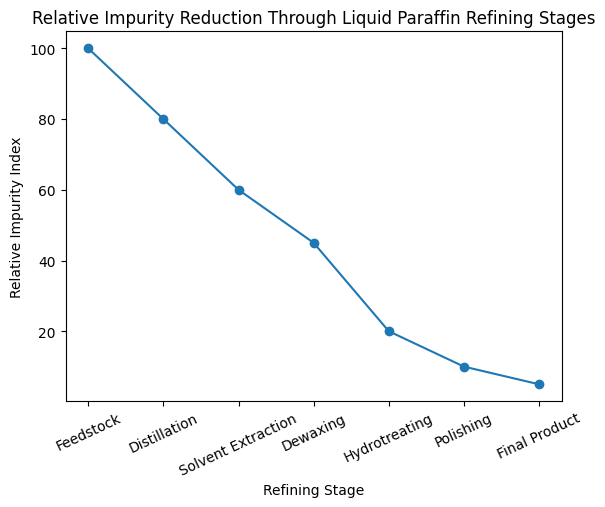
This chart illustrates how impurities are progressively reduced during liquid paraffin refining. Each stage removes specific contaminants, with hydrotreating delivering the largest purity improvement. Final polishing ensures batch consistency and water-white appearance for industrial applications.
Liquid paraffin grades differ because end-use needs differ, and a grade is essentially the combination of carbon-range, viscosity band, impurity profile, and compliance documentation offered by the supplier. For industrial customers, grade selection should start with application risk, since higher-contact or higher-visibility uses demand tighter odor, color, and impurity control, and they often require clearer documentation for audits and customer approvals.
Technical-grade liquid paraffin often targets industrial lubricants, rubber and plastic processing aids, and certain manufacturing operations where human contact is minimal and regulatory documentation is less strict. It can offer good lubricity and cost efficiency, yet buyers should still require stable viscosity and reasonable impurity limits, because impurities can still affect odor in processing areas, contribute to smoke or deposits at high temperature, and reduce compatibility with additives used in compounding.
Cosmetic-grade liquid paraffin must support low odor, high clarity, and stable sensory behavior in products, and this usually requires deeper hydrotreating and stronger polishing than technical-grade materials. When cosmetic formulators evaluate liquid paraffin, they focus on appearance, oxidation stability, and batch uniformity, because even small differences can change product feel, gloss, and long-term color under light exposure.
Pharmaceutical-grade liquid paraffin sits at the strict end of the spectrum, since it often needs compliance alignment with pharmacopeia requirements and tighter impurity control. Buyers typically expect robust batch traceability, controlled manufacturing systems, and consistent COA parameters, because variability can trigger audit issues, requalification events, and downstream manufacturing delays.
A buyer-friendly way to evaluate liquid paraffin is to translate “quality” into measurable metrics, then link each metric to operational impact in your plant and in your customers’ products. The table below highlights common parameters and why they matter in industrial decision-making.
Metric | What it indicates | Why it matters in use |
Kinematic viscosity | Flow behavior and molecular weight range | Controls dosing, lubrication, and product feel |
Color and appearance | Refining depth and polishing effectiveness | Affects visual quality and customer acceptance |
Odor | Residual impurities, aromatics, or processing issues | Impacts daily chemical and coating acceptability |
UV absorbance | Aromatic trace level proxy | Useful for sensitive formulations and compliance checks |
Sulfur content | Removal efficiency and stability | Reduces odor and improves long-term performance |
Density and volatility | Carbon range and evaporation behavior | Impacts flash behavior and product stability |
Metals and particulates | Filtration and contamination control | Reduces sediment and equipment wear |
Viscosity is more than a lab number, because it directly affects pumping, metering, spreadability, and film behavior, and it can influence how liquid paraffin carries pigments, plasticizers, or additives in blended systems. If viscosity shifts between batches, customers see unstable processing times or inconsistent product feel, so buyers should define acceptable viscosity bands and require evidence of batch stability across multiple production lots.
Color and odor are fast signals of refining depth, and they often reveal whether aromatics and reactive traces were adequately reduced through extraction and hydrotreating. UV transparency is valuable when the end product faces light exposure, since aromatic traces can contribute to discoloration over time, and for buyers in daily chemicals and coatings, a stable water-white oil reduces customer complaints and returns.
Lower sulfur and lower aromatics typically correlate with better stability and lower odor risk, and heavy metal control supports broader compliance needs and reduces the chance of catalytic degradation in customer formulations. For industrial applications that synthesize downstream chemicals, impurity limits can also affect reaction selectivity and yield, so tighter control can pay back through fewer byproducts and less purification load in the customer process.
Buyers often compare suppliers by price, but production method explains why prices differ and why performance differs, and it helps you decide whether a low-priced offer carries hidden risk. Traditional systems often relied on acid/clay routes for color improvement, while modern systems use hydroprocessing and controlled polishing, and the difference shows up in waste management, consistency, and ability to support higher-grade channels.
Older acid/clay methods can reduce color and some impurities, yet they often generate more hazardous waste streams and can produce inconsistent results when feed changes, which increases variability risk for downstream customers. In many markets, environmental constraints and waste-handling costs reduce the attractiveness of these systems, and buyers may see less stable documentation and less consistent batch performance from facilities that rely heavily on older approaches.
Hydroprocessing generally improves saturation and reduces heteroatoms more effectively, and it supports clearer and more consistent liquid paraffin outputs, especially when paired with strong filtration and disciplined QC release systems. For B2B buyers, hydroprocessing capability often correlates with better process control, stronger management systems, and a higher likelihood of stable long-term supply, which matters when you qualify an input across multi-year customer contracts.
Modern plants frequently recover and recycle process streams, and they optimize energy and hydrogen use, which reduces emissions per ton and can stabilize long-term operating costs. Buyers focused on environmental positioning may prefer suppliers who can document environmental compliance and consistent manufacturing controls, since those factors support customer ESG reporting and reduce supply disruption risk tied to regulatory enforcement.
Win produces Environmental Protection Liquid Paraffin with an annual capacity of 60,000 tons, supporting stable supply, multi-site delivery, and consistent batch performance. Its eco-friendly liquid paraffin serves plasticizers, lubricants, and coating industries, offering strong compatibility and smooth flow for polymer processing and coating leveling.
Every batch follows strict ISO-aligned quality control. Advanced equipment and R&D expertise enable large-scale production and customized grades to meet specific process needs. Win also provides multiple carbon ranges, allowing buyers to match viscosity and volatility to their applications, from daily chemicals to rubber and plastic processing.
Win product name | Carbon range | Positioning focus | Typical applications |
C10–C13 | Lighter, short-chain alkane range | Synthesize short-chain chlorinated paraffins and fatty alcohols, and support reactive pathways needing lighter feed | |
C11–C14 | Lightweight base oil behavior | Base oil for high-end daily chemicals, and use where low odor and smooth flow are required | |
C14–C17 | Balanced volatility and lubrication | Lubricant and release agent for rubber and plastic processing, supporting stable processing and demolding | |
C18–C21 | Heavier range for robust lubrication | Rubber and plastic processing support, and applications needing lower volatility and stronger film behavior |
Win also supports downstream manufacturing routes tied to chlorinated paraffin, and many customers use liquid paraffin as a feedstock because controlled carbon range can improve reaction consistency and help manage product specifications in chlorinated derivatives. When buyers evaluate cost, Win’s ability to deliver large volumes at stable quality can lower total cost of ownership, since fewer quality events mean fewer line stops, fewer customer complaints, and less rework, and those operational savings often exceed small differences in unit price.
Liquid paraffin is not a generic commodity. It comes from staged refining that removes aromatics, waxes, sulfur, and trace impurities to deliver stable flow, reliable lubrication, and consistent coating performance.
Win’s Environmental Protection Liquid Paraffin shows how scale, ISO quality control, and customized grades help reduce production costs while maintaining safety and performance.
A: Liquid paraffin is made through distillation, extraction, dewaxing, hydrotreating, and polishing to remove impurities.
A: Liquid paraffin quality depends on feedstock, hydrotreating depth, and batch filtration control.
A: Liquid paraffin supports plasticizers, lubricants, coatings, daily chemicals, and chlorinated paraffin production.
A: Buyers check COA data, viscosity, UV absorbance, sulfur limits, and ISO compliance.
A: Hydrotreated liquid paraffin offers lower odor, better stability, and safer industrial performance.


