
- All
- Product Name
- Product Keyword
- Product Model
- Product Summary
- Product Description
- Multi Field Search
Views: 0 Author: Site Editor Publish Time: 2026-02-09 Origin: Site


Ever wondered why liquid paraffin works for industry, skin, and tools? Many people seek safe results, clear guidance, and predictable performance across daily applications. In this guide, you’ll learn how to use liquid paraffin, choose the right grade, and apply it confidently.
Before applying liquid paraffin to skin, equipment, or formulations, it helps to understand what it actually is and why product specifications matter.
Liquid paraffin is a highly refined mineral oil derived from petroleum fractions through hydrotreating. During this process, impurities such as aromatics and sulfur compounds are removed, resulting in a clear, odorless hydrocarbon fluid composed primarily of saturated straight-chain alkanes. These molecular characteristics give liquid paraffin its smooth texture, oxidation resistance, and moisture-barrier behavior.
It is important to understand that liquid paraffin is not a vegetable oil, essential oil, or therapeutic medication. Instead, it serves as a functional material whose role changes depending on grade and formulation.
At its core, liquid paraffin acts as a physical barrier rather than a biological treatment. On skin, it reduces transepidermal water loss. In machinery, it forms a thin lubricating film. In chemical processing, it provides a stable hydrocarbon base.
However, it does not deliver nutrients, antimicrobial action, or mechanical load resistance unless combined with additives.
Three primary grades dominate the market:
| Grade | Typical Carbon Range | Primary Applications |
|---|---|---|
| Industrial / Technical | C18–C21 or broader | Lubricants, coatings, processing |
| Pharmaceutical | C15–C20 | Oral use, medical care |
| Cosmetic | C16–C22 | Skincare, haircare |
Each grade undergoes different purification standards and regulatory controls, which makes cross-use unsafe or ineffective.
Liquid paraffin is available in small consumer bottles, pump dispensers, droppers, and bulk industrial containers. Packaging influences both hygiene and dosing accuracy. Pump systems work well for daily skincare routines, while droppers support baby care or cosmetic formulation. Bulk drums suit manufacturing lines or maintenance workshops where volume consistency matters.
Choosing packaging based on frequency of use and contamination risk improves both safety and operational efficiency.
Several physical properties directly impact performance:
● Viscosity controls spreading behavior and oil film thickness.
● Odorlessness improves cosmetic acceptance.
● Low volatility reduces evaporation loss.
● Moisture-lock capability protects skin and surfaces.
These features explain why liquid paraffin remains popular in precision manufacturing, healthcare, cosmetics, and agriculture.
This section addresses the most intent-driven query: how to use liquid paraffin in daily life and professional environments.
How to Use Liquid Paraffin for Skin Moisturizing
Liquid paraffin functions as an occlusive agent that traps moisture inside the skin. For best results, users should apply it immediately after bathing while the skin remains slightly damp. A thin layer massaged into dry areas such as hands, heels, elbows, and knees helps restore softness and reduce cracking.
Night application offers extended hydration, especially when combined with cotton gloves or socks. Overuse should be avoided because thick layers can block pores and leave residue.
Clinics and skincare brands often prefer pump dispensers because they improve hygiene and dosing consistency.
How to Use Liquid Paraffin for Constipation Relief
Pharmaceutical-grade liquid paraffin works as a lubricant laxative by coating stool and intestinal walls. Adults typically take measured doses in the evening, followed by adequate hydration, with bowel movement often occurring the next morning (validation required).
Long-term use is discouraged, and individuals with abdominal pain or swallowing difficulty should consult healthcare professionals before use.
How to Use Liquid Paraffin for Hair and Scalp Care
For dry hair or flaky scalps, a small amount warmed between the palms can be applied to hair ends or massaged into the scalp before washing. This improves shine and reduces dryness, although excessive application may cause buildup. Mixing with shampoo or applying only to targeted areas improves rinse-out.
How to Use Liquid Paraffin as a Household Lubricant
Liquid paraffin supports light-duty lubrication for hinges, drawer tracks, zippers, and hand tools. A few drops wiped evenly across moving parts reduce friction and noise. However, it should never be used on electrical contacts, high-temperature components, or rubber seals.
How to Use Liquid Paraffin for Baby Care
Cosmetic-grade liquid paraffin is commonly used for diaper rash prevention and cradle cap softening. Parents should always dilute it and perform patch testing before broader application. For cradle cap, apply a thin layer, wait fifteen minutes, gently brush, and wash.
How to Measure and Apply Liquid Paraffin Correctly
Accurate measurement prevents waste and irritation. Droppers work well for infant care, pumps for skincare routines, and measuring spoons for oral use. Always start with small quantities and increase gradually.
Liquid paraffin integrates easily into daily personal care routines because of its neutral profile and barrier-forming ability.
Daily Skincare Routines with Liquid Paraffin
A simple moisture-lock routine includes cleansing, applying serum or lotion, then sealing dry zones with liquid paraffin. This approach helps retain hydration overnight and improves skin texture with consistent use.
Makeup Removal and Gentle Cleansing
Liquid paraffin dissolves waterproof makeup without stripping natural oils, making it suitable for sensitive skin. Users should follow removal with a mild cleanser to avoid residue.
Nail and Cuticle Conditioning
Weekly warm-oil treatments strengthen brittle nails and soften cuticles. After massage, covering hands with cotton gloves overnight enhances absorption.
Beyond personal care, liquid paraffin supports maintenance tasks across homes and workshops.
Cleaning and Rust Prevention
Applied to metal tools and blades, liquid paraffin forms a thin protective film that slows oxidation. Industrial C18–C21 grades, such as those supplied by Hebei Win New Material Co., Ltd., n-paraffin≥97% paraffin and ≤0.1% aromatics, ensuring clean protection without corrosive residues.
Craft, Leather, and Wood Applications
Artisans use liquid paraffin to condition leather and protect wood edges. C18–C21 molecules show lower swelling impact on plastics and elastomers compared to C22-containing blends, making them compatible with PET, ABS, and silicone components used in electronics and medical housings.
Candle Making and DIY Projects
In candle blends or hot-melt adhesives, liquid paraffin lowers freezing point while maintaining hardness, resulting in cleaner burning candles and lower curing temperatures for adhesives.
Selecting the proper grade directly affects performance, safety, and regulatory compliance.
Industrial buyers increasingly favor narrow-range C18–C21 liquid paraffin because it balances volatility and flash point while maintaining consistent viscosity.
| Application | Recommended Grade | Key Benefit |
|---|---|---|
| Lubrication or coatings | Industrial C18–C21 | Thermal stability |
| Oral or medical | Pharmaceutical | Safety and purity |
| Skincare or haircare | Cosmetic | Skin compatibility |
C18–C21 paraffin typically offers flash points ≥160°C, viscosities of 8–12 cSt at 40°C, and biodegradation rates ≥90% under OECD 301 standards.
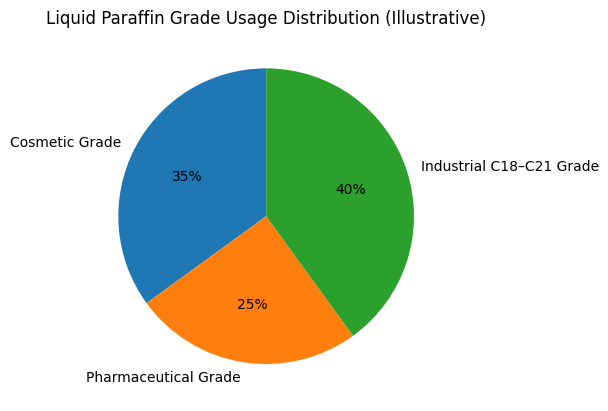
This chart illustrates the typical usage distribution of liquid paraffin by grade. Industrial C18–C21 products account for the largest share due to their versatility in lubrication, coatings, and chemical processing, followed by cosmetic and pharmaceutical grades used in personal care and medical applications.
Professional users should verify CAS numbers, MSDS availability, REACH compliance, FDA food-contact approvals, and LD50 values. Products from Hebei Win meet EU Ecolabel criteria and FDA 21 CFR 178.3570, supporting use in sustainable packaging and agricultural formulations.
High-quality liquid paraffin appears water-clear and odorless. Reputable suppliers provide batch traceability, carbon distribution analysis, and biodegradation data. Bulk buyers benefit from FIFO stock rotation and sealed storage.
C18–C21 liquid paraffin excels in medium-load precision lubrication for machine tool spindles, gearboxes, semiconductor equipment, and optical instruments. Its moderate viscosity forms uniform oil films on high-speed components, reducing friction loss while avoiding seizure caused by viscosity fluctuations.
In metal forming operations such as cold rolling and stretching, its low volatility reduces oil mist, while rapid surface coverage improves cooling and lubrication uniformity, lowering scratch risk. Field data suggests tool wear reductions up to 30% when used as lubricant additive (validation required).
C18–C21 straight-chain alkanes serve as premium feedstock for fatty alcohol synthesis. After hydrogenation, products such as stearyl alcohol (C18) and arachidyl alcohol (C20) often exceed 95% purity, enabling direct use in cosmetic emulsifiers and thickeners. This concentrated carbon distribution lowers purification costs and improves formulation stability.
Low VOC emissions and faster biodegradation make C18–C21 liquid paraffin suitable for agricultural carriers, where spray retention improves by approximately 20% (validation required), and soil microorganisms degrade residues within roughly sixty days.
In energy storage systems, these alkanes act as phase-change materials with transition temperatures near 20–30°C, offering stable volume change and long service life for building insulation and electronics heat management.
Liquid paraffin delivers far more than basic skincare benefits. When molecular distribution is controlled, as seen in C18–C21 environmental grades supplied by Hebei Win New Material Co., Ltd., it becomes a precision material supporting cosmetics, agriculture, metal processing, and sustainable packaging.
Successful use depends on selecting the correct grade, applying moderate quantities, and respecting operational limits. When handled properly, liquid paraffin from reliable manufacturers like Hebei Win New Material Co., Ltd. provides consistent performance, cleaner processing, and safer outcomes across both industrial supply chains and personal care.
A: Liquid paraffin supports selected industrial applications, skincare, constipation relief, baby care, and light lubrication when the correct grade is chosen.
A: Apply a thin layer of liquid paraffin to damp skin after bathing to lock in moisture and reduce dryness.
A: Liquid paraffin grades differ by purity and carbon range, which determines safety for industrial use, medical, or cosmetic.
A: Yes, liquid paraffin works for hinges and tools, but avoid electrical parts and high-heat areas.
A: Liquid paraffin offers longer-lasting moisture barriers, while natural oils provide nutrients but evaporate faster.
A: Use less liquid paraffin and apply only to targeted areas for better absorption.


