
- All
- Product Name
- Product Keyword
- Product Model
- Product Summary
- Product Description
- Multi Field Search
Views: 187 Author: Site Editor Publish Time: 2026-01-30 Origin: Site


Many buyers ask, what is liquid paraffin? They see it in industrial applications, skincare, medicine, and factories.Liquid paraffin sounds simple, yet grades differ. Wrong choices can affect quality and compliance.In this guide, you will learn what liquid paraffin is, how it works, and how to choose the right grade.
Liquid paraffin is a highly refined petroleum-derived hydrocarbon liquid composed mainly of saturated linear alkanes. Through advanced refining processes such as hydrogenation and adsorption, manufacturers remove aromatic compounds, sulfur, nitrogen, and other impurities, producing a clear, odorless, and chemically inert oil suitable for sensitive applications.
Its molecular stability allows liquid paraffin to remain non-reactive under most operating conditions, which explains its widespread use as a carrier oil, lubricant, solvent, and formulation base across industrial, medical, and cosmetic markets.
Liquid paraffin originates from crude petroleum distillation, followed by deep purification. The final product contains predominantly straight-chain hydrocarbons, offering consistent viscosity and excellent oxidation resistance. This refined structure prevents polymerization, sediment formation, or color change during long-term storage when kept sealed and protected from light.
Because it lacks unsaturated bonds or branched chains, liquid paraffin does not readily react with acids, alkalis, oxidants, or reducing agents, making it an ideal neutral medium in chemical processing and product formulation.
These three terms often describe similar substances, but usage depends on region and industry. Mineral oil dominates North American consumer markets, white oil appears frequently in industrial documentation, while liquid paraffin is common in pharmaceutical and cosmetic contexts. The real distinction lies in purification level and certification.
| Term | Common Market | Typical Purity Level | Main Applications |
|---|---|---|---|
| White Oil | Industrial | Medium | Manufacturing, machinery |
| Liquid Paraffin | Pharma / Cosmetic | Very High | Medicines, skincare |
| Mineral Oil | Consumer / Technical | Medium–High | Personal care, light industry |
Grades further divide into industrial, pharmaceutical, cosmetic, and food-grade categories, each meeting specific regulatory standards such as USP, BP, or food-contact approvals.
Liquid paraffin offers stable viscosity, strong moisture-locking ability, low volatility, and excellent lubricity. It forms a protective film on surfaces, resists oxidation, and maintains consistent performance across temperature variations. These properties support its use as a skin barrier, mold release agent, reaction solvent, and equipment lubricant.
The degree of purification determines suitability for end use. Industrial grades prioritize performance characteristics such as solvency and lubricity, while pharmaceutical and cosmetic grades undergo deeper hydrogenation and filtration to remove trace impurities. Buyers should always confirm certification documents such as COA, MSDS, and regulatory compliance before purchasing.
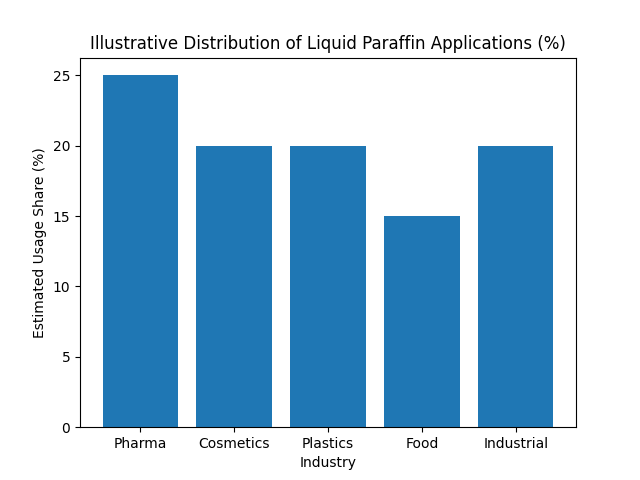
Liquid paraffin supports a wide range of industries due to its inert chemistry and predictable physical behavior. Its versatility allows manufacturers to standardize formulations while maintaining safety and performance.
In manufacturing environments, liquid paraffin functions as a light lubricant, mold release agent, and processing aid for plastics, rubber, and textiles. It prevents sticking during extrusion and molding while supporting smooth equipment operation. Textile processors also use it to improve fiber handling and finishing consistency.
In healthcare, liquid paraffin serves as a mild laxative, ointment base, and skin protectant. Pharmaceutical manufacturers also use it as an excipient carrier to ensure even dispersion of active ingredients. Its low allergen profile and chemical neutrality make it suitable for topical products and controlled oral formulations when pharmaceutical grade is applied.
Cosmetic brands rely on liquid paraffin for moisturizers, baby oils, makeup removers, and barrier creams. It creates an occlusive layer on skin that reduces water loss and improves softness, particularly for dry or sensitive skin types. Unlike many plant oils, it does not oxidize or develop odors over time, which supports long shelf life and consistent sensory performance.
Food-grade liquid paraffin coats fruits and confectionery to enhance appearance and slow moisture loss. Processing facilities also use it as a machinery lubricant where incidental food contact may occur, provided appropriate certifications are in place.
Industry | Typical Application | Purpose |
Pharma | Ointments, excipients | Carrier and skin protection |
Cosmetics | Creams, baby oil | Moisture retention |
Plastics | Mold release | Improved demolding |
Food | Fruit coating | Shelf-life extension |
Liquid paraffin offers several advantages over vegetable oils and synthetic alternatives, especially in long-term stability and operational predictability.
Its saturated hydrocarbon structure resists oxidation, giving it a long shelf life without rancidity. This stability reduces waste and reformulation risks for manufacturers managing extended storage cycles.
Liquid paraffin remains non-reactive and rarely causes irritation, which explains its presence in baby products and medical creams. Its purity level directly influences safety, emphasizing the importance of certified sourcing.
Large-scale petroleum refining supports consistent global supply, allowing businesses to secure stable pricing for bulk volumes.
Plant oils degrade faster and show variable viscosity, while liquid paraffin maintains uniform behavior across batches.
Property | Liquid Paraffin | Vegetable Oil |
Rancidity | No | Yes |
Viscosity Stability | High | Medium |
Shelf Life | Long | Short |
Odor | Neutral | Natural |
In industrial settings, liquid paraffin often appears as C10–C13 n-paraffinic liquid wax, a linear alkane blend designed for fine chemical synthesis and precision processing. A commercial example comes from Hebei Win New Material Co., Ltd., which supplies customizable C10–C13 grades for chemical manufacturers, plastics processors, and coating producers.
Typical characteristics include carbon numbers from C10 to C13, boiling points between approximately 174°C and 235°C, flash points above 60°C, and impurity levels below 0.2%, ensuring no interference from olefins, aromatics, sulfur, or nitrogen compounds. This composition allows the product to remain liquid at room temperature, enabling pumping, stirring, and dilution without heating, which reduces energy consumption.
Its balanced volatility avoids excessive evaporation while still offering strong solvency for oils, waxes, surfactants, and certain polymer resins. Chemical inertness prevents side reactions during synthesis, protecting product yield and purity.
C10–C13 grades support several downstream processes:
● Production of short-chain chlorinated paraffin used as flame-retardant plasticizers in PVC, polyurethane foam, rubber, coatings, and adhesives
● Conversion into linear fatty alcohols and fatty amines for detergents, textile auxiliaries, oilfield chemicals, and water treatment agents
● Sulfonation and phosphation into lubricant additives that improve anti-wear and rust protection
● Oxidation into fatty acids for food additives, pharmaceutical intermediates, and plasticizers
Linear paraffin chains improve reaction predictability and reduce catalyst poisoning risks.
Safety depends on grade selection and proper handling. Pharmaceutical liquid paraffin requires controlled dosing for oral use, as excessive intake may interfere with nutrient absorption. Topical application remains safe when certified grades apply.
Cosmetic-grade liquid paraffin complies with EU and FDA regulations, provided impurity thresholds remain within approved limits. Industrial grades require attention to flash point, container compatibility, and spill response planning. Operators typically need only basic chemical PPE due to its non-corrosive nature and lack of irritating vapors.
Storage best practices include sealed drums or flexitanks, shaded warehouses, and clean transfer systems to avoid contamination.
Selecting the correct grade starts with defining end use. Pharmaceutical products demand USP or BP certification. Cosmetic formulations require cosmetic-grade purity. Manufacturing operations may prioritize viscosity, flash point, and solvency.
Key specifications to review include viscosity, impurity profile, COA, and MSDS. Supply chain reliability also matters. Trusted suppliers provide batch traceability, consistent quality, and technical documentation.
Parameter | Why It Matters |
Carbon Range | Controls volatility and solvency |
Impurity Level | Protects catalysts and skin safety |
Flash Point | Determines handling risk |
Certification | Ensures regulatory compliance |
Packaging | Affects logistics cost |
For bulk purchasing, flexitank shipments often reduce per-ton transportation costs compared to drum packaging, especially for international deliveries.
Always request sample testing before committing to container-scale orders.
Liquid paraffin remains a versatile and cost-effective solution across industrial, medical, cosmetic, and food sectors. Its chemical stability, safety profile, and consistent performance make it a reliable formulation and processing aid when the correct grade applies. In industrial supply chains, manufacturers such as Hebei Win New Material Co., Ltd. support this versatility by providing customizable C10–C13 liquid paraffin grades designed for fine chemical synthesis, plastics processing, and specialty applications.
Success begins with clarity on application requirements, purity standards, and supplier capability. By matching purpose to specification and partnering with qualified producers like Hebei Win New Material Co., Ltd., businesses protect product quality, streamline operations, and strengthen long-term value.
A: Liquid paraffin is a refined mineral oil used in industrial lubrication, cosmetics, pharmaceuticals, and food processing.
A: Liquid paraffin supports skincare formulas, medical ointments, mold release, chemical synthesis, and light machinery lubrication.
A: Liquid paraffin offers chemical stability, low odor, long shelf life, and consistent viscosity across batches.
A: Prices depend on grade and volume, but liquid paraffin remains cost-effective for bulk chemical and processing applications.
A: Liquid paraffin resists oxidation and rancidity, while vegetable oils degrade faster in storage.


