
- All
- Product Name
- Product Keyword
- Product Model
- Product Summary
- Product Description
- Multi Field Search
Views: 174 Author: Site Editor Publish Time: 2026-02-04 Origin: Site


Why do so many industries rely on one simple oil? Liquid paraffin powers factories, food lines, and skincare through clean, stable performance. In this guide, you will learn what liquid paraffin is used for. You will also see why it matters and how to choose the right grade.
Liquid paraffin serves as both an active processing aid and an inert carrier fluid across multiple industries. Its saturated alkane structure—composed solely of C–C and C–H bonds—provides inherent resistance to oxidation, hydrolysis, and chemical degradation, which explains its widespread adoption in environments where product stability and cleanliness matter.
Industrial manufacturers rely on liquid paraffin for textile finishing, rubber processing, plastic molding, and temporary rust protection. C11–C14 lightweight liquid paraffin, with viscosity around 1.5–3.0 cSt at 40°C, excels in applications requiring rapid coverage and clean evaporation.
It dissolves waxes, resins, and oils efficiently, making it a preferred solvent in metal degreasers and aerosol polishes. In furniture care and automotive detailing sprays, it can reduce drying time by up to 40% compared with heavier C16–C18 paraffins (validation required), improving production throughput and end-user experience.
In healthcare and pharmaceutical manufacturing, liquid paraffin functions as a laxative agent, skin protectant, ointment base, and tablet lubricant. Pharmaceutical-grade liquid paraffin undergoes deep refining to remove aromatic hydrocarbons, sulfur compounds, and trace impurities, ensuring compliance with USP, BP, or EP standards.
Its smooth coating action reduces friction during tablet compression and capsule filling, while its inert nature prevents interference with active pharmaceutical ingredients. Because it remains stable up to approximately 100°C, it also supports cyclic processing environments such as medical ointment production lines or topical formulation mixing tanks.
Importantly, sulfur content typically remains below 0.05%, which minimizes irritation risk and supports regulatory approval for ingestible or dermal-contact products.
Medical buyers should always request recent batch COA documentation and pharmacopoeia certification before approving suppliers.
Cosmetic formulators increasingly favor C11–C14 lightweight liquid paraffin as a “refreshing emollient,” particularly in oil-control creams, sunscreen sprays, foundations, and lightweight moisturizers. Compared with traditional long-chain C18+ paraffins, C11–C14 grades evaporate more quickly after application, leaving a soft, dry-touch finish that avoids the heavy or greasy feel commonly associated with mineral oils.
This controlled volatility makes lightweight paraffin especially suitable for oily skin products and warm-climate cosmetics, where rapid absorption and minimal residue improve consumer acceptance. Its low viscosity also enhances pigment dispersion in foundations and improves spray performance in aerosol formulations.
Unlike botanical oils, which can oxidize or change odor over time, liquid paraffin remains colorless and odorless throughout shelf life, helping brands maintain consistent product quality across long distribution cycles.
Food-grade liquid paraffin plays a critical role in modern food manufacturing, where it acts as a conveyor lubricant, mold release agent, and fruit coating material. In bakery operations, it prevents dough adhesion on molds and belts, while in produce packaging it helps reduce moisture loss from fruit surfaces.
C11–C14 lightweight liquid paraffin offers a unique balance of moderate volatility and low residue, allowing equipment to stay clean while minimizing buildup on rollers and guides. Flash points typically range from 60–80°C, enabling safe storage under standard warehouse conditions without special cooling systems.
Food processors should always confirm EU VOC compliance and food-contact migration testing before introducing new paraffin grades into production.
Beyond core industries, liquid paraffin supports livestock care formulations, pesticide carriers, household polishes, and hygiene products. In agriculture, C11–C14 alkanes act as effective solvents in pesticide emulsions, enabling uniform dispersion of active ingredients while allowing gradual release over time. Compared with long-chain waxes, these lighter alkanes biodegrade faster in soil, reducing long-term residue risks.
| Industry | Typical Uses | Performance Benefit |
|---|---|---|
| Manufacturing | Degreasing, mold release | Rapid coverage, solvency |
| Pharmaceuticals | Ointments, tablets, laxatives | Chemical stability, low irritation |
| Cosmetics | Sunscreens, foundations, sprays | Fast evaporation, non-greasy feel |
| Food Processing | Conveyors, mold release | Clean operation, low residue |
| Agriculture | Pesticide carriers | Controlled volatility |
Tip: Always match liquid paraffin grade to end-use requirements, since incorrect purity or viscosity can lead to compliance issues or reduced performance.
Liquid paraffin consistently outperforms vegetable oils and many synthetic alternatives due to its superior stability, neutrality, and cost predictability. It resists oxidation, remains odorless over time, and does not react with pigments, fragrances, or active ingredients, making it ideal for sensitive formulations.
From a procurement perspective, liquid paraffin also offers predictable global pricing and scalable supply chains, which simplifies budgeting for high-volume operations. Its compatibility with plastics, rubber seals, metals, and skin-contact surfaces further reduces the need for multiple specialty fluids.
C11–C14 lightweight paraffins additionally show lower swelling effects on nitrile and natural rubber—approximately half that of long-chain waxes—supporting reliable use in hydraulic seals and equipment gaskets.
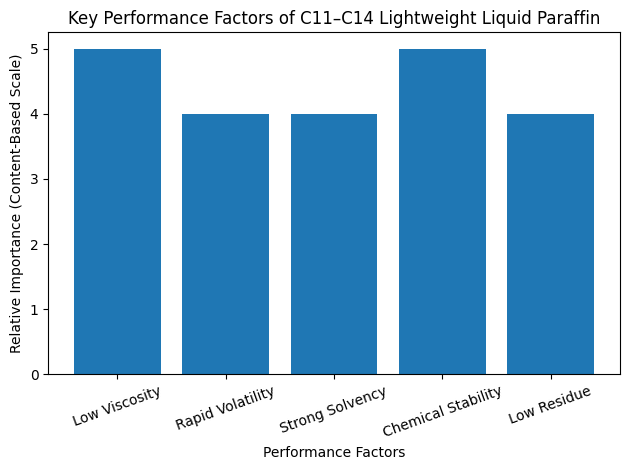
Liquid paraffin grades differ primarily in refinement depth, impurity limits, and viscosity.
Grade | Typical Application | Purity Level |
Pharmaceutical | Medical, ingestible | Highest |
Cosmetic | Skincare, haircare | High |
Technical | Industrial processing | Moderate |
C11–C14 lightweight paraffins generally exhibit kinematic viscosity between 2–5 mm²/s at 25°C, allowing them to penetrate micro-gaps in precision components such as electronic pins, clock gears, and drone motor bearings. This low viscosity supports rapid lubrication without excessive power loss.
When reviewing datasheets, buyers should focus on carbon range, flash point, sulfur content, appearance, and viscosity. For example, Hebei Win New Material Co., Ltd.’s Lightweight Liquid Paraffin 1# specifies C11–C14 composition, flash point >60°C, sulfur ≤0.05%, and clear colorless appearance, making it suitable for aerosols, industrial cleaners, and cosmetic carriers.
Always verify batch-specific COA and MSDS documents before approving bulk shipments.
In plastics and rubber processing, liquid paraffin acts as a mold release agent and flow enhancer, improving surface finish and reducing part defects. Textile manufacturers use it to reduce fiber friction during weaving, where it later evaporates during heat setting, eliminating post-processing washing steps.
Metalworking operations incorporate lightweight paraffin into cutting fluids and ultrasonic cleaners, where its strong fluidity enables rapid heat dissipation and low-residue cleaning. Precision equipment manufacturers apply it to micro-motors, conveyors, and bearings, benefiting from its ability to form uniform oil films without introducing drag.
Refined liquid paraffin is classified as non-hazardous under GHS standards, although standard industrial hygiene practices still apply. Operators should avoid prolonged skin contact, prevent aerosol inhalation, and maintain clean transfer systems.
Storage should occur in sealed containers, away from open flames and direct sunlight, while environmental disposal must follow local regulations. Compared with long-chain waxes, C11–C14 paraffins biodegrade faster, offering reduced environmental persistence.
Successful selection begins by matching grade to application, whether medical, cosmetic, food, or industrial. Buyers should evaluate supplier documentation carefully, ensuring access to COA, MSDS, and traceable batch records.
For B2B operations, bulk purchasing considerations include packaging format (disposable flexible tank, drum, IBC, tanker), delivery lead times, and long-term pricing contracts. Hebei Win New Material Co., Ltd. provides C11–C14 Lightweight Liquid Paraffin 1optimized for aerosols, textile auxiliaries, industrial cleaners, and cosmetic formulations, supported by consistent quality control and technical documentation.
Comment: Locking annual volume contracts can help manufacturers stabilize raw material costs and protect margins.
Liquid paraffin plays a key role across manufacturing, cosmetics, food processing, agriculture, and pharmaceuticals. C11–C14 lightweight grades offer rapid volatility, low viscosity, strong solvency, and clean evaporation for efficient production and high-quality results. Products such as C11–C14 Lightweight Liquid Paraffin 1from Hebei Win New Material Co., Ltd. provide consistent specifications and reliable performance for real-world applications.
Choosing the right grade and supplier makes the difference. For stable supply, technical support, and flexible bulk options, Hebei Win New Material Co., Ltd. welcomes inquiries for samples and quotations.
A: Liquid paraffin is used in industrial, cosmetics, pharmaceuticals, food processing, and manufacturing as a stable carrier, lubricant, and protective fluid.
A: Liquid paraffin offers chemical stability, low odor, and consistent performance, making it reliable for sensitive and large-scale applications.
A: Match liquid paraffin grade to your application—industrial, pharma, cosmetic, or food —based on purity and viscosity requirements.
A: Liquid paraffin is cost-effective in volume, especially lightweight grades that reduce cleaning and processing costs.
A: Liquid paraffin improves lubrication, speeds drying, reduces residue, and supports cleaner production across many industries.


