
- All
- Product Name
- Product Keyword
- Product Model
- Product Summary
- Product Description
- Multi Field Search
Views: 0 Author: Site Editor Publish Time: 2026-02-16 Origin: Site


Liquid paraffin powers many industries, yet few understand its origins.
What materials shape its safety and performance?In this article, we explain how liquid paraffin is made.
You will learn about crude oil, refining steps, and grade differences.
Liquid paraffin is a highly refined mineral oil composed primarily of saturated hydrocarbons, often referred to as alkanes, which remain fluid at room temperature and display excellent chemical stability, low reactivity, and consistent flow behavior across a wide operating range.
Solid paraffin, by contrast, contains heavier wax fractions that crystallize as temperatures drop, making it suitable for candles, packaging, and coatings but unsuitable for applications that demand continuous lubrication, smooth spreading, or uniform blending.
Although both materials originate from petroleum, their molecular weight distribution, melting behavior, and end-use performance differ significantly, which is why liquid paraffin becomes the preferred choice for precision industrial processes, pharmaceuticals, and cosmetics.
This section directly addresses the core question by breaking down every major material involved, from the initial petroleum feedstock to the finishing agents that deliver crystal-clear, low-odor oils.
All liquid paraffin begins with crude petroleum, but not all crude oils are equally suitable for producing high-purity mineral oils, because their hydrocarbon composition varies widely depending on geographic origin and reservoir chemistry.
Refiners generally prefer paraffinic crude, which contains a higher proportion of straight-chain hydrocarbons that hydrogenate more easily and yield cleaner base oils, while naphthenic crude, rich in cyclic compounds, often requires more intensive processing and can produce darker or less stable products unless treated aggressively.
Major producing regions, including parts of the Middle East and North America, supply paraffinic crudes commonly used for mineral oil production, and these sources form the backbone of many pharmaceutical- and cosmetic-grade liquid paraffin supply chains.
Liquid paraffin is not drawn directly from raw crude, because refineries first separate petroleum into fractions through atmospheric distillation, removing light gases, gasoline, and kerosene before routing heavier streams into vacuum distillation units.
From this secondary process, refiners obtain vacuum gas oil and heavy neutral distillates, which fall into the molecular weight and boiling point range suitable for mineral oil production, typically between 300°C and 600°C, and these fractions become the primary feedstock for liquid paraffin manufacturing.
Hydrogen plays a central role in transforming raw distillates into safe, stable liquid paraffin, because hydrotreating uses high-pressure hydrogen to remove sulfur, nitrogen, and aromatic compounds while saturating unsaturated bonds that would otherwise compromise color, odor, and oxidative stability.
This step not only improves sensory qualities but also reduces potentially harmful residues, making hydrogenation essential for meeting pharmaceutical and cosmetic standards.
Hydrogen alone cannot drive these reactions efficiently, so refiners rely on catalysts, most commonly systems based on nickel, molybdenum, and cobalt supported on alumina, which accelerate hydrogenation and impurity removal under controlled temperature and pressure conditions.
Catalyst selection influences refining severity, energy consumption, and final purity, and modern catalyst designs help manufacturers achieve deeper saturation while preserving yield, which directly impacts production economics.
Even after hydrotreating, oil streams still contain waxy components that can impair low-temperature flow, so manufacturers apply solvent dewaxing using agents such as methyl ethyl ketone (MEK) and toluene, which dissolve oil while allowing wax crystals to form and be mechanically separated.
This step improves pour point, clarity, and consistency, especially for grades intended for cold environments or precision applications.
Following dewaxing, trace impurities and color bodies remain, which is why liquid paraffin undergoes final polishing with activated carbon and bleaching clays that adsorb residual aromatics and pigments, delivering the water-clear appearance expected in cosmetic and pharmaceutical markets.
This stage often determines whether a batch qualifies as premium grade, because it directly affects visual clarity and odor neutrality.
Some industrial liquid paraffin grades may include small amounts of antioxidants or stabilizers to extend shelf life under high-temperature or oxidative conditions, although food, cosmetic, and pharmaceutical grades avoid additives entirely to comply with regulatory frameworks and customer safety expectations.
Manufacturing begins with atmospheric distillation, where crude oil separates into light and heavy fractions, followed by vacuum distillation that processes residual streams at reduced pressure to prevent thermal cracking while isolating suitable base oil cuts.
These operations establish the molecular foundation of the final product, making distillation control a critical quality lever.
After distillation, solvent dewaxing removes crystalline waxes, while hydrofinishing applies milder hydrogen treatment to eliminate remaining odor-causing compounds and improve UV stability, creating a smoother, more neutral oil that performs reliably in sensitive formulations.
Before packaging, liquid paraffin passes through fine filtration systems and undergoes comprehensive testing, including viscosity, density, sulfur content, UV absorbance, and color measurements, with pharmaceutical grades also subject to microbial screening and batch traceability audits.
Modern producers combine advanced equipment with R&D expertise to support large-scale output while maintaining tight quality tolerances, which allows them to supply tens of thousands of tons annually without compromising consistency or environmental compliance.
Different grades reflect different raw material controls and refining intensity, which is why buyers must align grade selection with application risk and regulatory exposure.
Industrial grades accept wider raw material ranges and may include stabilizers, making them appropriate for rubber processing, coatings, and machinery lubrication where performance outweighs cosmetic appearance.
Pharmaceutical grade starts with high-quality paraffinic crude and undergoes deep hydrotreating, multi-stage polishing, and strict analytical verification to meet USP, BP, or EP specifications, making it suitable for oral medicines and topical healthcare products.
Cosmetic grade follows similar processing but allows slightly broader limits on certain parameters, such as UV absorbance, while still requiring excellent clarity, low odor, and skin compatibility for use in creams, lotions, and personal care formulations.
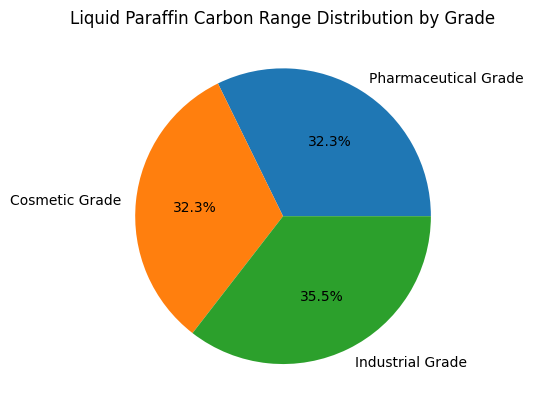
Below is a simplified comparison that helps buyers visualize how material selection and refining depth translate into practical grade differences:
Grade Type | Feedstock Quality | Refining Depth | Typical Carbon Range | Common Applications |
| Industrial | Mixed or moderate quality | Moderate | C10–C21 | Plastics, lubricants |
| Pharmaceutical | Very high paraffinic crude | Deep hydrotreating + polishing | C11–C21 | Medicines, ointments |
Cosmetic | High paraffinic crude | Moderate to deep | C11–C21 | Skincare, haircare |
Crude oil composition directly affects polycyclic aromatic hydrocarbon (PAH) formation, because aromatic-rich feedstocks demand more severe treatment to achieve safe levels, making paraffinic crude the preferred starting point for low-toxicity liquid paraffin.
Deeper hydrogenation removes reactive molecules that can irritate skin, which is why cosmetic brands often specify ultra-low UV absorbance and strict impurity limits to ensure consumer comfort and regulatory compliance.
Incomplete hydrogenation leaves sulfur traces that cause yellow tint and unpleasant odor, while properly controlled hydrogen pressure and catalyst activity deliver odorless, water-clear oils with longer shelf life and better oxidative stability.
In many regions, white mineral oil is simply another name for cosmetic or pharmaceutical liquid paraffin, with differences largely driven by labeling conventions rather than chemistry.
Synthetic hydrocarbons offer tighter molecular control but come at significantly higher cost and production complexity, making liquid paraffin the more economical and widely accepted choice for most applications.
Liquid paraffin combines low production cost, proven stability, and global pharmacopeia recognition, which explains its dominance in industrial, healthcare, and personal care markets.
Major regulatory frameworks define strict limits on sulfur, aromatics, heavy metals, and UV absorbance, which only carefully selected raw materials and well-controlled refining processes can consistently meet.
Reputable suppliers provide certificates of analysis, batch numbers, and feedstock origin documentation, enabling downstream manufacturers to maintain audit-ready records and protect brand reputation.
Non-compliant liquid paraffin faces customs delays, rejected shipments, and failed customer audits, so reliable sourcing backed by ISO-certified quality systems becomes a strategic advantage for exporters and multinational buyers.
Before signing long-term contracts, audit supplier traceability systems and request recent third-party inspection reports.
Modern producers increasingly combine high-capacity equipment, environmental protection measures, and in-house R&D to deliver large volumes of eco-focused liquid paraffin while maintaining consistent performance, which allows them to support plasticizers, lubricants, and coating industries at scale without sacrificing safety standards.
Carbon-range customization, such as C10–C13 lightweight grades for fast-flow formulations, C14–C17 balanced cuts for lubricants and coatings, and C18–C21 heavier fractions for longer-lasting release and lubrication, helps customers match viscosity and volatility to specific processes, including rubber and plastic manufacturing, fatty alcohol synthesis, and short-chain chlorinated paraffin production (validation required by region).
When paired with strict batch quality control and ISO-aligned certification, these capabilities help buyers reduce production costs while maintaining high compatibility, reliable flow properties, and regulatory confidence across diverse applications.
Liquid paraffin is far more than a simple refinery byproduct, because it emerges from a tightly controlled chain that starts with paraffinic crude petroleum and continues through vacuum distillation, hydrogen treatment, catalyst refining, solvent dewaxing, and carbon polishing—a process professionally implemented by Hebei Win New Material Co., Ltd. through advanced equipment and strict quality management.
Understanding what materials are used to make liquid paraffin helps buyers evaluate suppliers, compare grades, and control application risk across industrial, pharmaceutical, and cosmetic uses, while Hebei Win New Material Co., Ltd. supports this process with ISO-compliant production, stable supply capacity, and customizable carbon-range grades.
High-quality liquid paraffin always begins with the right feedstock and ends with disciplined process control, and companies working with Hebei Win New Material Co., Ltd. gain stronger consistency, regulatory confidence, and long-term performance across plastics, coatings, personal care, and advanced manufacturing.
A: Liquid paraffin comes from paraffinic crude oil, refined using hydrogen, catalysts, solvents, and polishing media.
A: Liquid paraffin uses hydrogen to remove sulfur and aromatics, improving clarity, odor, and long-term stability.
A: Liquid paraffin stays fluid at room temperature, while solid paraffin contains waxes that harden when cooled.
A: Yes, industrial-grade liquid paraffin is suitable for technical and manufacturing uses when properly refined to meet performance requirements, such as lubrication, plastic processing, and equipment protection.
A: Feedstock quality, refining depth, certifications, and carbon range mainly influence liquid paraffin pricing.


