
- All
- Product Name
- Product Keyword
- Product Model
- Product Summary
- Product Description
- Multi Field Search
Views: 187 Author: Site Editor Publish Time: 2026-01-26 Origin: Site


Why do so many industries still rely on liquid paraffin, even as new materials appear? The answer is simple: it works, offering stability, safety, and consistent performance across many applications. In this article, you will learn why people use liquid paraffin, where it adds value, and how buyers choose the right grade.
Liquid paraffin is a highly refined hydrocarbon fluid derived from petroleum through controlled distillation and purification processes. During refining, aromatic compounds, sulfur, and reactive impurities are removed, leaving behind saturated straight-chain alkanes that offer excellent chemical stability and consistent physical behavior.
Modern suppliers often provide products with narrow carbon chain ranges, such as C14–C17, which helps reduce variation in viscosity, density, and freezing point. This uniformity allows manufacturers to maintain tighter quality control and more predictable downstream performance.
Many eco-focused liquid paraffin products also highlight compliance with REACH and FDA indirect food contact standards, which reflects growing demand for safer, regulation-ready raw materials.
People use liquid paraffin because it behaves consistently across a wide temperature range and does not easily oxidize or react with other ingredients. Its inert nature allows formulators to blend it into industrial products, pharmaceuticals, and cosmetics without disrupting chemical balance.
In mechanical systems, it creates a uniform lubricating film that lowers friction and wear. In processing environments, its low volatility and moderate flash point (often ≥100°C for C14–C17 grades) improve handling safety and storage stability. On skin, liquid paraffin forms a breathable occlusive layer that slows transepidermal water loss, helping maintain hydration and reduce irritation.
Some advanced eco-friendly liquid paraffin products also achieve biodegradation rates ≥90% under OECD 301 testing, offering a more sustainable alternative to traditional mineral oils.
Different applications require different purity levels, testing standards, and regulatory controls. Selecting the correct grade is critical for both compliance and performance.
| Grade | Typical Applications | Buyer Priority |
|---|---|---|
| Technical | Lubrication, mold release, processing aids | Viscosity control, cost efficiency |
| Pharmaceutical | Laxatives, ointment bases, medical preparations | USP/EP compliance, traceability |
| Cosmetic | Creams, lotions, hair care products | Sensory feel, stability, allergen safety |
Eco-friendly variants are now available across multiple grades, often emphasizing low VOC content, absence of heavy metals, and improved biodegradability.
Liquid paraffin remains popular because it delivers value across industrial environments, cosmetic, and medical, often solving multiple challenges with a single material.
Industrial users value liquid paraffin as a light-duty lubricant and mold release agent because it forms a smooth oil film on friction surfaces, reduces sticking during molding processes, and minimizes equipment wear. Its good fluidity allows rapid penetration into lubrication points, improving machine uptime.
In healthcare, liquid paraffin is commonly used as a lubricant laxative that softens stool and coats the intestinal lining, helping reduce discomfort during bowel movements. Doctors typically recommend short-term use, especially for post-surgical patients or individuals experiencing hard stools, while avoiding prolonged use due to aspiration concerns.
Cosmetic brands rely on liquid paraffin for its ability to lock in moisture, calm irritated skin, and support barrier repair. Its protein-free composition lowers allergenic potential, making it suitable for sensitive-skin and baby-care products.
Formulators prefer liquid paraffin over many plant oils because it does not oxidize easily, ensuring consistent texture and appearance throughout product shelf life. This stability reduces batch rejection and reformulation frequency, which matters for high-volume production.
Liquid paraffin also serves as a neutral carrier base in pharmaceutical creams and ointments, helping active ingredients spread evenly across skin while improving glide and application comfort.
Some liquid paraffin grades meet FDA indirect food contact requirements and are used to reduce sticking on packaging lines or condition processing surfaces, although buyers should always confirm region-specific approvals (validation required).
Hospitals and laboratories use liquid paraffin to protect metal tools from corrosion and support smooth assembly of sensitive components, benefiting from its chemical stability and low volatility.
C14–C17 liquid paraffin remains liquid at room temperature and offers excellent fluidity, which simplifies pumping, stirring, and mixing during textile fiber spinning, rubber compounding, and plastic surface finishing. Narrow carbon distributions also reduce fluctuations in viscosity and freezing point, supporting consistent product quality.
Manufacturers apply liquid paraffin as a mold release aid to prevent material adhesion, minimize defects, and shorten cleaning cycles. It also supports light-duty lubrication in metalworking and textile machinery, forming uniform films that reduce friction.
Some facilities use oil films to suppress dust or condition metal sheets, although environmental regulations vary by region and buyers should confirm biodegradability claims through standardized testing.
Because liquid paraffin works through lubrication rather than stimulation, clinicians sometimes prefer it when fiber or osmotic laxatives prove ineffective. It provides gentler relief in specific cases, although medical guidance remains essential to avoid misuse.
In wound care settings, liquid paraffin helps prevent cracking around dressings and supports skin comfort by reducing moisture loss. Its stable nature allows hospitals to store it long-term without degradation.
Medical device manufacturers often apply liquid paraffin during assembly to protect seals and reduce surface wear, while diagnostic labs may use hydrocarbon fluids during preparation steps, depending on protocol.
Healthcare buyers should request pharmacopeia certificates and batch traceability before approving suppliers.
Cosmetic chemists value liquid paraffin for its neutral behavior, predictable viscosity, and compatibility with fragrances and active ingredients. It improves spreadability, reduces drag during application, and supports consistent sensory profiles across production batches.
Eco-friendly C14–C17 liquid paraffin products now offer additional benefits, including lightweight texture, low toxicity profiles, and compliance with REACH and FDA indirect food contact criteria, making them attractive for modern clean-label formulations.
Unlike botanical oils that can oxidize or vary by harvest, liquid paraffin maintains uniform performance year-round, enabling brands to standardize formulations globally and reduce quality fluctuations.
Its non-reactive composition and low allergenic potential make liquid paraffin suitable for sensitive-skin products, while its resistance to oxidation supports extended shelf life and simplified preservation strategies.
Different applications require different performance profiles, so understanding how liquid paraffin compares with alternatives helps buyers make informed choices.
Feature | Liquid Paraffin | Glycerin |
Moisture action | Occlusive barrier | Humectant draw |
Skin feel | Smooth, protective | Can feel sticky |
Stability | High | Moderate |
Glycerin attracts water from the environment, while liquid paraffin seals moisture within the skin barrier, which is why many formulations combine both.
Silicone oils offer lighter sensory feel but often come at higher cost, whereas liquid paraffin provides strong value per kilogram and predictable sourcing, making it attractive for large-scale manufacturing.
Natural oils can vary in color, odor, and oxidation stability, while liquid paraffin delivers consistent performance across batches, reducing supply chain volatility and quality risk.
Comment: For high-volume SKUs, consistency often outweighs trend-driven ingredients.
Start by assessing end-use contact and regulatory exposure, then match industrial uses, pharmaceutical, cosmetic, or technical grade accordingly. Eco-friendly options may add sustainability benefits but still require the same rigorous documentation.
Buyers should request:
● Carbon number distribution
● Certificate of Analysis
● Viscosity at 40°C
● Flash point data
● Heavy metal limits
● REACH status
● FDA indirect food contact support (if relevant)
For example, an eco-friendly C14–C17 liquid paraffin product from Hebei Win New Material Co., Ltd. lists viscosity of 2.6–3.4 cSt at 40°C, flash point ≥100°C, water-white appearance, ≥90% biodegradation under OECD 301, and low VOC content, providing a useful reference framework for supplier evaluation.
Store liquid paraffin in sealed containers away from heat sources, maintain clear labeling by grade, and prevent cross-use between regulated and industrial lines.
Buyer Type | Key Requirement |
| Industrial | Viscosity tolerance |
| Pharma | USP/EP compliance |
Cosmetic | ISO documentation |
Build a one-page specification sheet to streamline supplier screening.
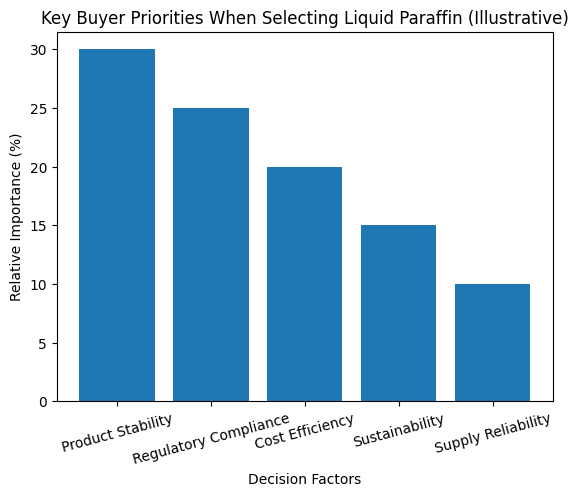
People continue to rely on liquid paraffin because it offers unmatched versatility, stability, and cost-effective performance across industrial manufacturing, healthcare, personal care, and agriculture manufacturing. When buyers select the correct grade and verify supplier documentation, liquid paraffin supports safer products, smoother operations, and lower total ownership cost—especially when sourced from experienced manufacturers like Hebei Win New Material Co., Ltd., known for its eco-friendly C14–C17 liquid paraffin solutions and consistent quality control.
Eco-friendly C14–C17 variants further enhance its appeal by combining excellent fluidity, chemical stability, and improved biodegradability, helping organizations meet sustainability goals without sacrificing functionality. Backed by REACH-aligned materials and FDA indirect food contact support, Hebei Win New Material Co., Ltd. provides dependable supply for global B2B buyers seeking performance and compliance in one solution.
A: People use liquid paraffin for its stability, safety, and consistent performance in industrial manufacturing, healthcare, and cosmetics.
A: Liquid paraffin is used for industrial processing support, skin care, light lubrication, and pharmaceutical bases.
A: Liquid paraffin offers longer shelf life and stable quality, while natural oils can vary by harvest.
A: Buyers select liquid paraffin based on application, purity needs, and supplier certification.
A: Eco-friendly liquid paraffin may cost slightly more, but it reduces compliance risk and supports sustainability goals.
A: Liquid paraffin delivers predictable supply, easy handling, and lower total ownership cost.


